Carbide Drill Bits: When They Beat Cobalt and HSS
Carbide drill bits are made of tungsten carbide, a material much harder than the high-speed steel (HSS) and cobalt steel used in most twist bits. They stay sharp at higher cutting temperatures, which is why they drill hardened steel, cast iron and abrasive materials that wear other bits out quickly. Carbide is also brittle, so it cuts well only when the bit is held perfectly steady; any wobble can chip or snap it.
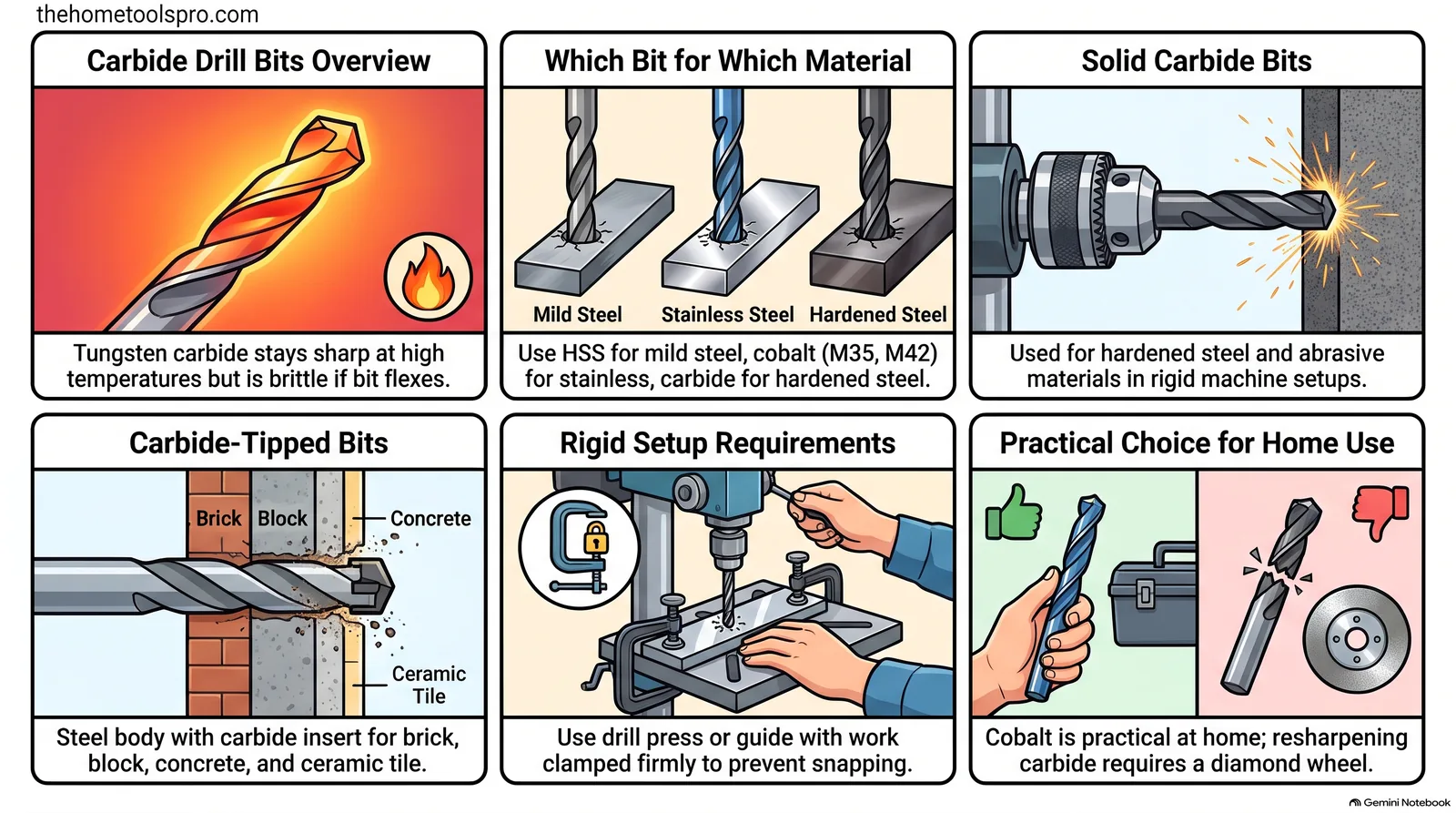
There are two kinds, and they suit different jobs. Solid carbide bits are carbide all the way through and are used for metal in rigid machines. Carbide-tipped bits have a steel body with a carbide insert brazed onto the tip, and they’re what you buy for masonry, concrete and tile.
Carbide vs cobalt vs HSS
| HSS | Cobalt (M35, M42) | Solid carbide | |
|---|---|---|---|
| Material | High-speed steel | Steel with about 5% (M35) or 8% (M42) cobalt | Tungsten carbide bonded with cobalt |
| Hardness | Good | Higher, and holds it when hot | Much higher |
| Toughness | Flexible, forgiving | A little more brittle than HSS | Brittle: chips if it flexes |
| Best for | Wood, plastic, aluminum, mild steel | Stainless, cast iron, harder steels | Hardened steel, abrasive and production work |
| Hand drill? | Yes | Yes | Only with great care; a drill press is better |
| Resharpening | Easy on a bench grinder | Easy | Needs a diamond wheel |
| Price | Low | Medium | High |
For stainless steel and most hard steels at home, cobalt is usually the practical choice; see best cobalt drill bits for hardened steel. Carbide makes sense when cobalt dulls too fast, for example in hardened tool steel, or when you drill many identical holes in a machine.
Solid carbide bits: for hardened steel and machine work
Solid carbide bits drill materials that are too hard for HSS and cobalt, including hardened steel parts, some spring steels and abrasive materials like fiberglass and circuit boards. They need three things to survive:
- A rigid setup. Use a drill press, a mill or a drill guide, with the work clamped firmly. Any sideways movement can snap a small carbide bit.
- The right speed and steady feed. Carbide can run faster than HSS, but in hardened steel the feed must be even, without stopping and rubbing.
- Coolant or cutting fluid, so the edge and the work stay cool and chips clear.
Breaking off a solid carbide bit in a part is a real problem: the stub is too hard to drill out with ordinary bits. Go slowly when you’re learning.
Carbide-tipped bits: masonry, concrete and tile
Most carbide bits sold for home use are carbide-tipped. A small carbide plate at the tip does the cutting while the tough steel body takes the twisting load. They come in three common forms:
- Masonry bits with a flat, chisel-like carbide tip for brick, block and concrete, used in a hammer drill or rotary hammer.
- Spear-point tile and glass bits, which grind a clean hole through glazed ceramic tile without hammer action.
- Carbide-tipped hole saws for thin metal, plastics and fiberglass.
Which bit for which material?
| Material | Best bit |
|---|---|
| Wood, plastic | HSS or brad point |
| Mild steel, aluminum | HSS or titanium-coated HSS |
| Stainless steel | Cobalt (M35 or M42) |
| Hardened steel | Solid carbide in a rigid setup, or cobalt for a few holes |
| Brick, block, concrete | Carbide-tipped masonry bit |
| Glazed ceramic tile | Carbide spear-point tile bit |
| Porcelain tile, stone, glass | Diamond core bit |
For a full comparison of metal bits, see best drill bits for metal. Drilling stainless has its own speed and coolant rules, covered in best drill bits for stainless steel.
Frequently asked questions
Can you use carbide drill bits in a hand drill?
Carbide-tipped masonry and tile bits, yes: they're made for it. Small solid carbide bits are brittle and snap if the drill wobbles or tilts, so they belong in a drill press or a guide.
Are carbide bits better than cobalt for stainless steel?
For most home and shop drilling, cobalt is the better choice: tougher, cheaper and easy to resharpen. Solid carbide wins in production work and very hard steels, with a rigid machine and coolant.
Can carbide drill bits be sharpened?
Yes, but only with a diamond wheel. Ordinary grinding wheels don't cut carbide, so most people replace worn carbide bits or send them to a sharpening service.
Related guides
- Guide
How to Drill Into Stucco Without Cracking It
How to drill into stucco: the right masonry bit, drill settings, how to avoid cracks and chips, how to hit the framing, and how to seal the hole afterward.
- Guide
Hole Saw Arbor: Sizes and How to Fit One
What a hole saw arbor is, the standard arbor sizes and shank types, how to match one to your hole saw and drill, and how to fit, remove and replace one.
- Guide
Diamond Hole Saws: Tile, Glass and Stone
What a diamond hole saw is, which sizes and types suit tile, glass, porcelain and stone, how to use one wet, and how it differs from a regular hole saw.