Masonry Drill Bits: How to Drill Concrete and Brick
To drill concrete and brick, use a carbide-tipped masonry drill bit in a hammer drill. For holes larger than about 1/2 in, or many holes in poured concrete, use an SDS-plus bit in a rotary hammer. The bit’s diameter must match the anchor you’re installing: a 1/4 in wedge anchor goes in a 1/4 in hole; a 3/16 in concrete screw needs a 5/32 in hole.
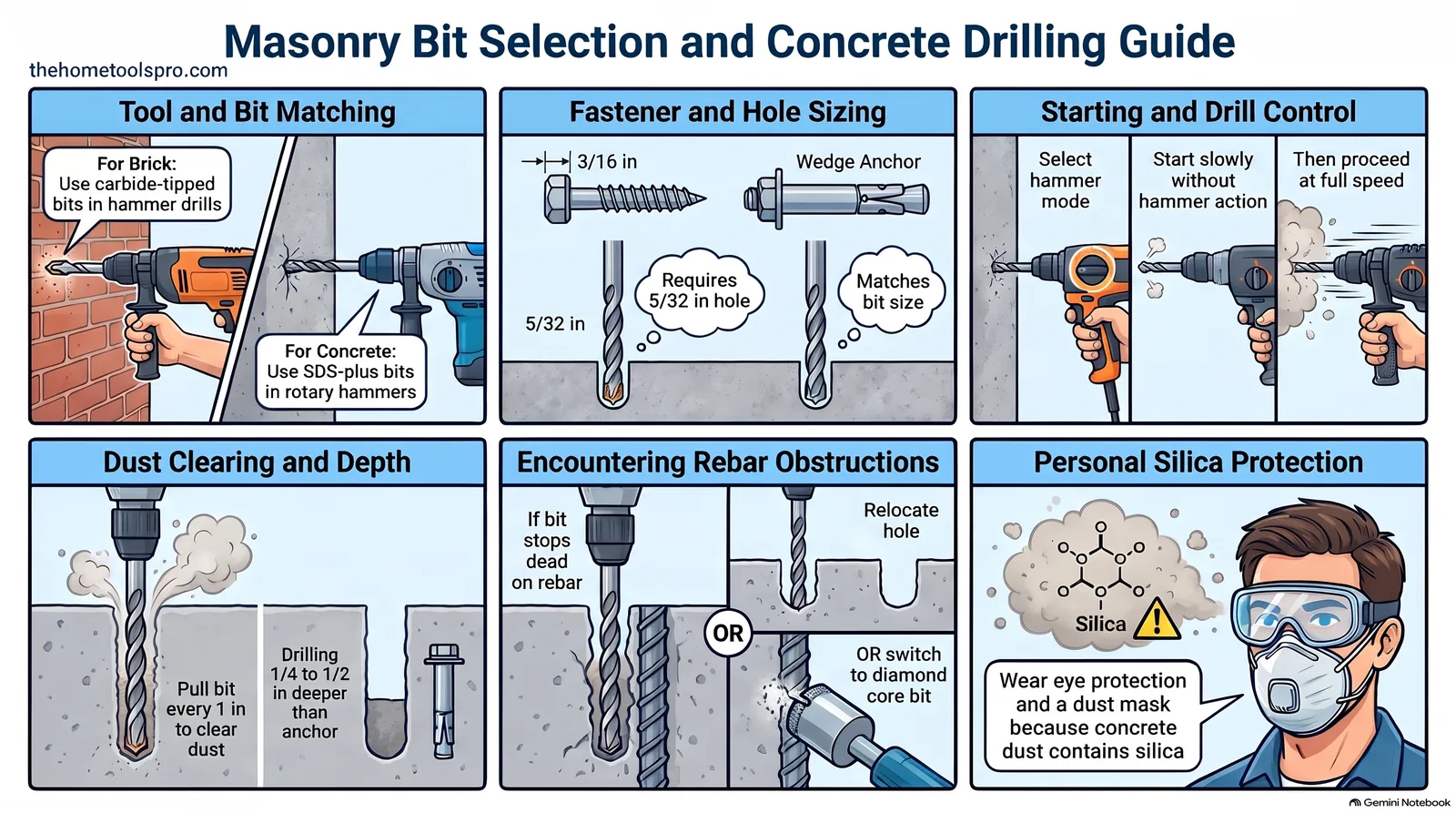
A masonry bit doesn’t slice material like a metal drill bit. Its flat carbide tip chips and crushes the stone, the hammer action breaks it up, and the spiral flutes carry the dust out.
Types of masonry drill bits
| Bit type | Shank | Use in | Best for |
|---|---|---|---|
| Carbide-tipped masonry bit | Round or hex | Hammer drill, or a regular drill for soft brick | Brick, block, mortar, occasional concrete holes up to about 1/2 in |
| SDS-plus bit | SDS-plus (slotted 10 mm shank) | Rotary hammer (SDS-plus) | Poured concrete, anchors, holes from about 5/32 in to 1-1/8 in |
| SDS-max bit | SDS-max (larger 18 mm shank) | Heavy rotary hammer | Large holes and core bits, roughly 1/2 in and up |
| Multi-material bit | Round or hex | Drill or hammer drill | Mixed jobs: tile, brick, wood and plasterboard with one bit |
| Diamond core bit | Various | Core drill or rotary hammer (rotation only) | Clean large holes, through rebar, for pipes and cables |
SDS bits only fit SDS tools. The slotted shank lets the bit slide back and forth in the chuck, so the hammer energy goes into the bit instead of the chuck. That’s why a rotary hammer drills concrete several times faster than a hammer drill. If you’re deciding which tool you need, read can a hammer drill be used as a regular drill.
Which bit size for wall anchors?
Use the size printed on the anchor packet. The common ones:
| Fastener | Drill bit size |
|---|---|
| 3/16 in concrete screw (Tapcon-type) | 5/32 in |
| 1/4 in concrete screw | 3/16 in |
| 1/4 in wedge anchor | 1/4 in |
| 3/8 in wedge anchor | 3/8 in |
| 1/2 in wedge anchor | 1/2 in |
| Plastic wall plug, 6 mm (brown/red) | 6 mm, or as marked |
| Sleeve anchor | Same as the anchor’s diameter |
Drill the hole about 1/4 to 1/2 in deeper than the anchor so dust left in the hole doesn’t stop it seating. Then blow or vacuum the dust out: dust left in the hole is the most common reason anchors pull out.
How to drill into concrete step by step
- Mark and check. Mark the spot, and scan for pipes and cables first in walls and floors.
- Select hammer mode on the hammer drill, or rotary-hammer mode (not chisel) on an SDS tool.
- Start slowly without hammer for the first few millimetres so the tip doesn’t wander, then switch hammer on and go to full speed.
- Let the tool work. Push firmly but don’t lean your whole weight on it; too much force slows the hammer action.
- Pull the bit out every 1 in or so to clear dust, especially in deep holes.
- If the bit stops dead, you’ve probably hit rebar. Don’t force it: move the hole, or switch to a rebar-cutting or diamond core bit.
Use a depth stop or a piece of tape on the bit to get the depth right, and wear eye protection and a dust mask; concrete dust contains silica.
Drilling into brick and block
Brick and concrete block are softer than poured concrete, so a carbide-tipped masonry bit in a hammer drill is plenty. A few things differ:
- Hollow block and old brick can crack. Start without hammer, and use hammer only if the bit stops progressing.
- Brick or mortar joint? Brick gives the stronger hold for heavy loads like TV mounts. Mortar is softer and easier to patch later, so it suits light items.
- Hollow blocks need hollow-wall anchors, not solid-concrete anchors, if you drill through into the void.
Masonry bit vs other bits
Don’t use a masonry bit for steel: it rubs instead of cutting. For metal, use drill bits for metal such as cobalt or HSS. For glazed tile on a wall, a masonry bit chips the glaze; use a tile or diamond bit until you’re through the tile, then switch to masonry for the brick or concrete behind it. The drill bit size chart converts the fractional and metric sizes used on anchor packets.
Frequently asked questions
Can a regular drill drill concrete?
Slowly, for a few small holes in soft brick or block. For poured concrete you need hammer action: a hammer drill for occasional holes up to about 1/2 in, a rotary hammer with SDS bits for bigger or many holes.
Is it better to drill into brick or mortar?
Brick gives a stronger hold for heavy loads. Mortar is softer, easier to drill and easier to repair later, so it suits light fixings and rented homes.
Why does my masonry bit stop cutting?
Usually the hammer mode is off, the bit has hit rebar, or the carbide tip is worn round. Check the mode, pull the bit out to clear dust, and replace the bit if the tip edges are rounded.
Related guides
- Best picks
7 Best Brad Point Drill Bit Sets for Woodworking
Brad point drill bit sets for clean, accurate holes in wood: what the center spur does, sizes and shank types, plus seven sets compared.
- Guide
Can You Drill Through Cast Iron? Bits, Speed and Steps
Yes, cast iron can be drilled with cobalt or TiN-coated HSS bits. Which bit, what speed, why gray iron is drilled dry, and the step-by-step method.
- Guide
How to Get a Stuck Drill Bit Out of a Drill Chuck
How to remove a drill bit stuck in the chuck, whole or snapped off: loosening a jammed keyless or keyed chuck, and how to stop it happening again.