How to Get a Stuck Drill Bit Out of a Drill Chuck
To get a stuck drill bit out of a drill chuck, take the battery out (or unplug the drill), grip the chuck sleeve firmly through a rag or with a strap wrench, and turn it counterclockwise (as seen from the front) while holding the drill body still. A sharp tap on the sleeve with a rubber mallet often breaks a jammed chuck loose. If the bit has snapped off, open the jaws as far as they go and pull the stub out with locking pliers.
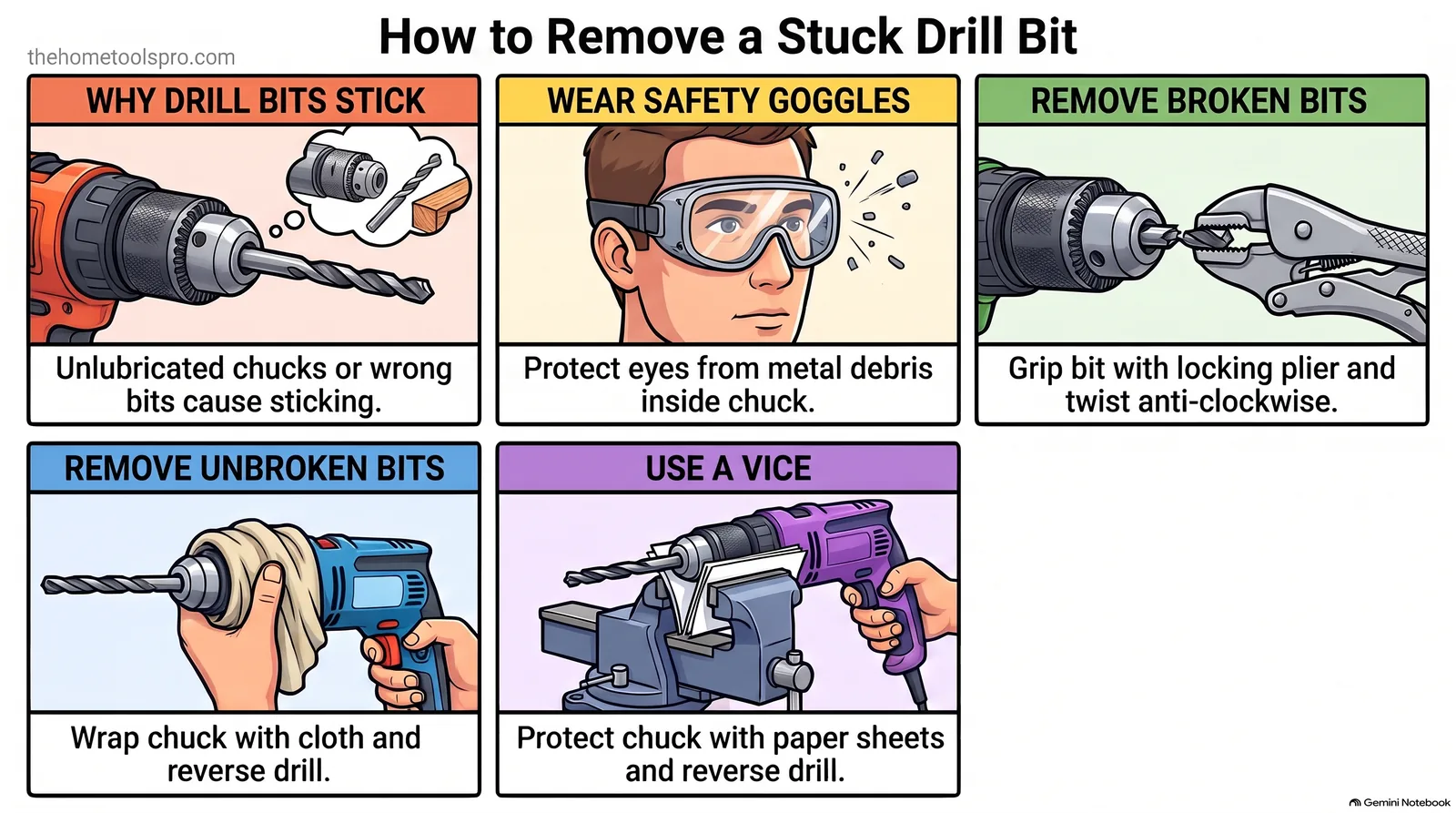
Why bits get stuck in the chuck
- Overtightening. A keyless chuck tightens itself further during heavy drilling, especially if you tightened it by holding the sleeve and running the motor.
- A short or broken stub that’s sitting too deep for your fingers to reach.
- Dirt and rust in the jaws, or a damaged jaw from a bit spinning in the chuck.
- The wrong shank: a bit only just inside the jaws, or a hex shank gripped on its corners.
Keyless chuck: step by step
- Remove the battery or unplug the drill, and set the direction switch to the center (lock) position.
- Hold the drill body firmly and turn the chuck sleeve counterclockwise. On single-sleeve chucks the spindle locks automatically; on two-sleeve chucks, hold the rear ring and turn the front one.
- More grip: wrap the sleeve in a rag, a rubber jar opener or a strap wrench, and try again.
- Shock it loose: tap around the sleeve with a rubber mallet in the loosening direction, then try by hand again.
- Still stuck: clamp the chuck sleeve (padded with cardboard or soft jaws) in a vise, put the battery back, set the drill to reverse at the lowest speed and pulse the trigger briefly. The motor turns the spindle against the held sleeve and releases the jaws. Keep your hands clear of the chuck and use only short pulses.
Keyed chuck
Put the chuck key in one of the holes and turn it counterclockwise. If it won’t move, tap the key’s handle with a mallet, then try each of the other key holes in turn. If the key’s teeth or the chuck’s teeth are worn, the key will slip; replace the key before it damages the chuck further.
Broken bit stuck in the chuck
- Wear safety glasses; there may be loose chips inside.
- Open the jaws fully. A stub that’s free will drop out when you tip the drill.
- If part of the stub sticks out, grip it with locking pliers and pull while opening the jaws.
- If it’s jammed between the jaws, close and open the chuck a few times to shift it, then pull it out.
Bit stuck in the hole instead
If the bit is stuck in the workpiece rather than the chuck, set the drill to reverse and pull back gently while it turns. Don’t open the chuck and leave the bit behind; if it breaks off flush, a left-hand drill bit or an extractor is the next step.
How to stop it happening
- Push the shank fully into the jaws and tighten the chuck by hand, not by running the motor against it.
- Use bits whose shank suits the chuck; do all drill bits fit all drills explains which shanks go where.
- Blow out dust and chips from the chuck now and then, and put a drop of light oil on the jaws if they feel gritty.
- If the jaws are chipped or the chuck wobbles, replace it; 1/2 in vs 3/8 in drill explains how chucks come off.
Related guides
Related guides
- Guide
Hole Saw Sizes: Chart From 3/4 in to 6 in and Uses
Standard hole saw sizes in inches and mm, what each size cuts, which hole saw type suits wood, metal, tile and masonry, and how to cut a clean hole.
- Best picks
6 Best Brad Point Drill Bit Sets for Woodworking
Brad point drill bit sets for clean, accurate holes in wood: what the center spur does, sizes and shank types, plus six sets compared.
- Guide
Can You Drill Through Cast Iron? Bits, Speed and Steps
Yes, cast iron can be drilled with cobalt or TiN-coated HSS bits. Which bit, what speed, why gray iron is drilled dry, and the step-by-step method.