Do All Drill Bits Fit All Drills? Shanks and Chucks
No, not every drill bit fits every drill. What decides it is the bit’s shank and the drill’s chuck. A standard three-jaw chuck, keyed or keyless, holds round, hex and three-flat shanks of any brand, up to its capacity (usually 3/8 or 1/2 inch). An impact driver only takes 1/4-inch hex-shank bits. SDS-plus and SDS-max bits fit only rotary hammers with that chuck. Brand doesn’t matter: a DeWalt bit fits a Makita drill if the shank suits the chuck.
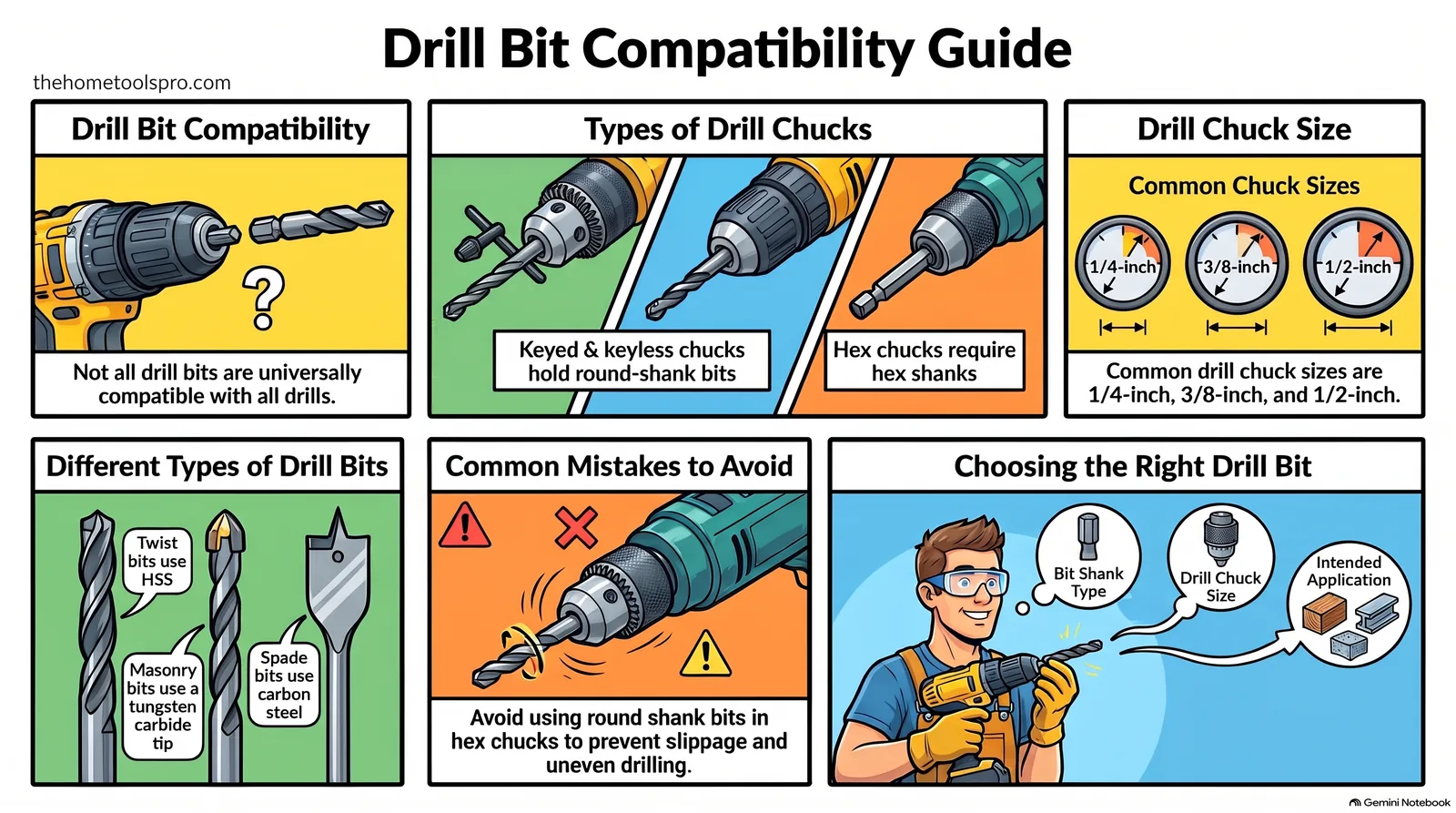
Which shanks fit which drills
| Shank | Drill/driver (3-jaw chuck) | Impact driver (1/4-in hex) | Hammer drill (3-jaw chuck) | SDS-plus rotary hammer | Drill press |
|---|---|---|---|---|---|
| Round, up to chuck capacity | Yes | No | Yes | Only with a chuck adapter | Yes |
| Three-flat (tri-flat) | Yes | No | Yes | Only with a chuck adapter | Yes |
| 1/4-inch hex | Yes | Yes | Yes | Only with a chuck adapter | Yes |
| SDS-plus | No | No | No | Yes | No |
| SDS-max | No | No | No | No (needs SDS-max) | No |
Three-flat and hex shanks don’t change what fits; they stop the bit spinning in the chuck under load.
Check your chuck’s capacity
The capacity is usually printed on the chuck, for example “1.5–13 mm” or “1/32–1/2 in”. The upper number is the largest shank it holds; the lower one the smallest. A 3/8-inch chuck can still drill holes bigger than 3/8 inch with bits that have a smaller shank: spade bits, hole saw arbors, step bits and reduced-shank twist bits are made for this (Silver and Deming bits do the same for 1/2-inch chucks, with 1/2-inch shanks on bits up to 1 inch or more). 1/2 in vs 3/8 in drill explains the two chuck sizes.
Bit types and the drills they need
- Twist bits (HSS, cobalt, black oxide): any 3-jaw chuck; hex-shank versions also go in impact drivers. See the drill bit size chart for sizes.
- Spade bits, step bits and hole saws: usually 1/4-inch hex or three-flat shanks, so they fit both drills and impact drivers. In an impact driver, use bits labeled impact-rated.
- Masonry bits: round or three-flat shanks go in a hammer drill (or a regular drill for soft brick and block). SDS-plus masonry bits need a rotary hammer, which drills concrete much faster. Masonry drill bits for concrete and brick covers the choice.
- Countersink bits and driver bits: usually 1/4-inch hex, for drills and impact drivers.
- Large Forstner and auger bits: round or hex shanks up to 1/2 inch; best in a 1/2-inch drill or a drill press.
How to fit a bit in a three-jaw chuck
- Open the jaws wider than the shank.
- Push the bit in until the shank is fully inside the jaws, but don’t bottom out a small bit against the back of the chuck.
- Tighten the sleeve by hand until it clicks or stops; on a keyed chuck, tighten with the key in at least two of the holes.
- Run the drill briefly. If the bit wobbles, it’s off-center between the jaws: open, re-seat it and tighten again.
Common mistakes
- Putting an SDS bit in a regular chuck. The jaws can’t hold the grooved shank properly and there’s no hammer action of the right kind.
- Using non-impact bits in an impact driver. Ordinary hex bits can snap at the shank under the hammering blows.
- Forcing a shank that’s too big. If it doesn’t slide in with the jaws fully open, the chuck is too small; use a reduced-shank bit or a larger drill.
If a bit gets jammed in the chuck, see how to get a stuck drill bit out of a drill chuck.
Related guides
Related guides
- Guide
Hole Saw Sizes: Chart From 3/4 in to 6 in and Uses
Standard hole saw sizes in inches and mm, what each size cuts, which hole saw type suits wood, metal, tile and masonry, and how to cut a clean hole.
- Best picks
6 Best Brad Point Drill Bit Sets for Woodworking
Brad point drill bit sets for clean, accurate holes in wood: what the center spur does, sizes and shank types, plus six sets compared.
- Guide
Can You Drill Through Cast Iron? Bits, Speed and Steps
Yes, cast iron can be drilled with cobalt or TiN-coated HSS bits. Which bit, what speed, why gray iron is drilled dry, and the step-by-step method.