Tap Drill Size Chart: UNC, UNF, Metric and NPT
A tap drill is the drill you use before tapping, sized so the tap cuts a thread of about 75% depth. A 1/4-20 tap needs a #7 drill (0.201 in), a 3/8-16 tap a 5/16 in drill (0.3125 in), a #10-24 tap a #25 drill (0.1495 in), and an M6 x 1.0 tap a 5.0 mm drill. The charts below cover every common UNC, UNF, metric and NPT size.
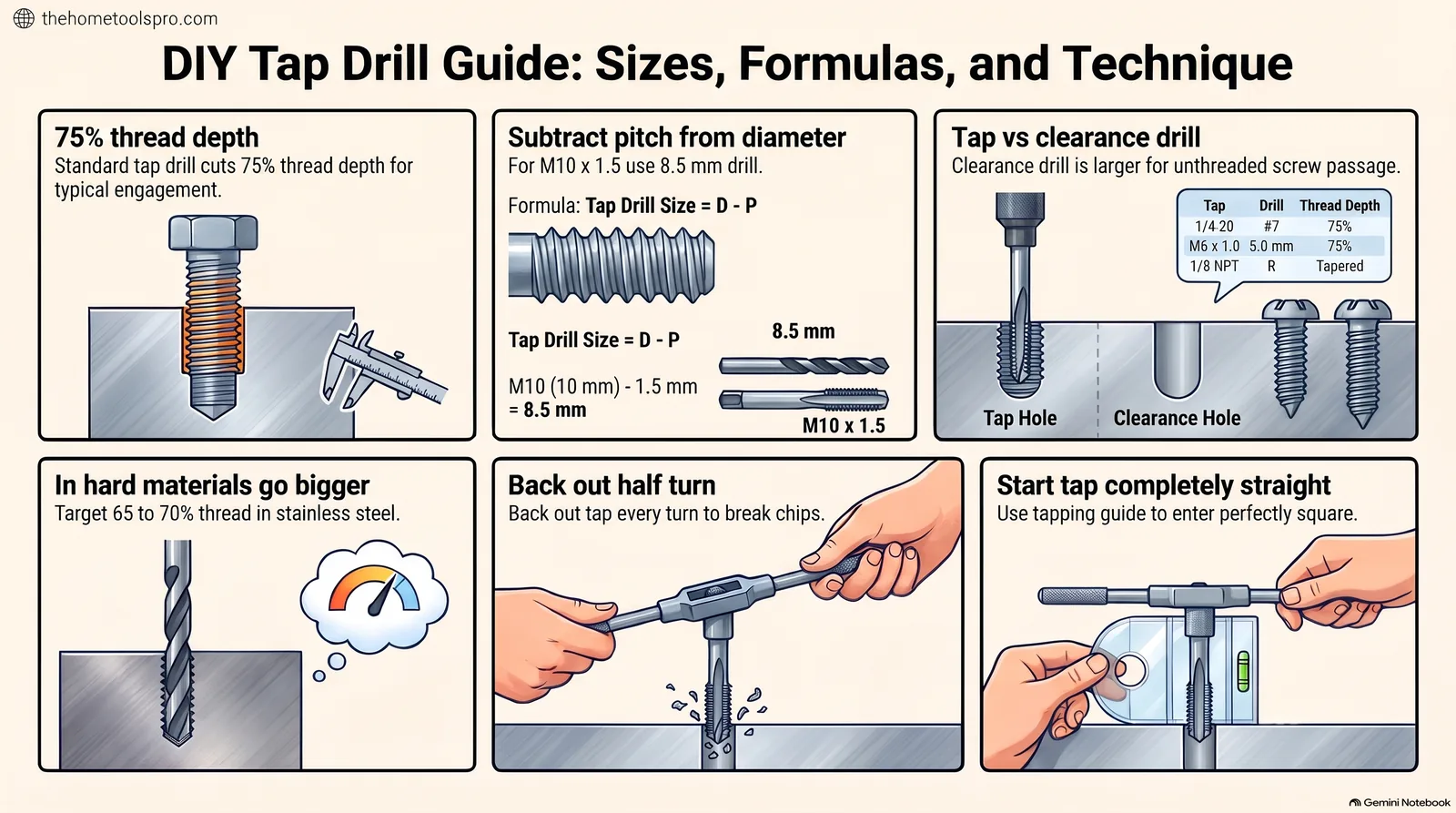
For metric coarse threads you can work it out yourself: subtract the pitch from the nominal diameter. For M10 x 1.5 that’s 10 minus 1.5, so an 8.5 mm drill.
UNC (coarse) tap drill sizes
| Tap | Drill | Decimal (in) | mm |
|---|---|---|---|
| #4-40 | #43 | 0.0890 | 2.26 |
| #6-32 | #36 | 0.1065 | 2.71 |
| #8-32 | #29 | 0.1360 | 3.45 |
| #10-24 | #25 | 0.1495 | 3.80 |
| #12-24 | #16 | 0.1770 | 4.50 |
| 1/4-20 | #7 | 0.2010 | 5.11 |
| 5/16-18 | F | 0.2570 | 6.53 |
| 3/8-16 | 5/16 | 0.3125 | 7.94 |
| 7/16-14 | U | 0.3680 | 9.35 |
| 1/2-13 | 27/64 | 0.4219 | 10.72 |
| 9/16-12 | 31/64 | 0.4844 | 12.30 |
| 5/8-11 | 17/32 | 0.5313 | 13.49 |
| 3/4-10 | 21/32 | 0.6563 | 16.67 |
| 7/8-9 | 49/64 | 0.7656 | 19.45 |
| 1-8 | 7/8 | 0.8750 | 22.23 |
Some charts list a #26 drill (0.147 in) for #10-24, which gives a slightly fuller thread; #25 is the standard 75% size and taps more easily.
The 1/4-20 is the size people search for most; it has its own page explaining the 1/4-20 tap drill bit size and the matching clearance hole.
UNF (fine) tap drill sizes
| Tap | Drill | Decimal (in) | mm |
|---|---|---|---|
| #4-48 | #42 | 0.0935 | 2.37 |
| #6-40 | #33 | 0.1130 | 2.87 |
| #8-36 | #29 | 0.1360 | 3.45 |
| #10-32 | #21 | 0.1590 | 4.04 |
| #12-28 | #14 | 0.1820 | 4.62 |
| 1/4-28 | #3 | 0.2130 | 5.41 |
| 5/16-24 | I | 0.2720 | 6.91 |
| 3/8-24 | Q | 0.3320 | 8.43 |
| 7/16-20 | 25/64 | 0.3906 | 9.92 |
| 1/2-20 | 29/64 | 0.4531 | 11.51 |
| 9/16-18 | 33/64 | 0.5156 | 13.10 |
| 5/8-18 | 37/64 | 0.5781 | 14.68 |
| 3/4-16 | 11/16 | 0.6875 | 17.46 |
| 7/8-14 | 13/16 | 0.8125 | 20.64 |
| 1-12 | 59/64 | 0.9219 | 23.42 |
Metric coarse tap drill sizes
| Tap | Pitch (mm) | Drill (mm) | Nearest inch drill |
|---|---|---|---|
| M3 | 0.5 | 2.5 | #39 / #40 |
| M4 | 0.7 | 3.3 | #30 |
| M5 | 0.8 | 4.2 | #19 |
| M6 | 1.0 | 5.0 | #9 |
| M8 | 1.25 | 6.8 | H |
| M10 | 1.5 | 8.5 | Q / 21/64 |
| M12 | 1.75 | 10.2 | 13/32 |
| M14 | 2.0 | 12.0 | 15/32 |
| M16 | 2.0 | 14.0 | 35/64 |
| M20 | 2.5 | 17.5 | 11/16 |
Use the metric drill when you have it. The inch equivalents are the closest common sizes, not exact matches.
Metric fine threads follow the same rule: M8 x 1.0 takes a 7.0 mm drill, M10 x 1.25 an 8.75 mm drill and M12 x 1.5 a 10.5 mm drill.
NPT (pipe thread) tap drill sizes
| Pipe tap | Drill | Decimal (in) |
|---|---|---|
| 1/16 NPT | 1/4 | 0.2500 |
| 1/8 NPT | R (or 11/32) | 0.3390 |
| 1/4 NPT | 7/16 | 0.4375 |
| 3/8 NPT | 37/64 | 0.5781 |
| 1/2 NPT | 23/32 | 0.7188 |
| 3/4 NPT | 59/64 | 0.9219 |
| 1 NPT | 1-5/32 | 1.1563 |
These are the sizes for tapping without reaming. If you ream the hole with a tapered pipe reamer first, use the next size down (for example Q, 0.332 in, for 1/8 NPT), which is why some charts list smaller drills.
NPT threads are tapered, so they seal as they tighten. Tap only until the fitting goes in by hand about 3 to 4 turns; tapping deeper makes a leaking, loose joint.
How to choose and use the right tap drill
- Drill sizes use three systems. Number (#1 to #80), letter (A to Z) and fractional drills fill in each other’s gaps. If you don’t own the exact size, the drill bit size chart lists every number and letter drill in decimal inches and millimetres, so you can find the nearest one.
- In hard materials, go slightly bigger. In stainless steel or hardened steel, a drill one size larger than the chart (about 65 to 70% thread) makes the tap much less likely to break, and the thread is still strong enough for most uses.
- In soft materials, the chart size is right. Aluminum, brass and mild steel tap cleanly at 75%.
- Use cutting fluid. Tapping oil on steel and stainless, a light oil or wax on aluminum. Back the tap out half a turn every turn or two to break the chip.
- Start straight. A tap that enters at an angle cuts a crooked thread and snaps easily; a tapping guide or a drill press (unpowered, turned by hand) keeps it square.
Tap drill vs clearance drill
The tap drill is for a hole you will cut threads into. The clearance drill is for a hole the screw passes through without threading, so it’s larger than the screw. For a #10 screw, for example, the clearance hole is about 0.196 in (#9) for a close fit; see drill bit size for a #10 screw for pilot and clearance holes in wood and metal.
Related guides
Frequently asked questions
How do you calculate a metric tap drill size?
Subtract the pitch from the nominal diameter: M8 x 1.25 needs 8 - 1.25 = 6.75, so a 6.8 mm drill. This gives about 75% thread engagement, the usual target.
What drill size for a 1/4-20 tap?
A #7 drill (0.201 in). A 13/64 in drill (0.2031 in) is the closest fractional size and works when you don't have a #7.
Why is 75% thread used for tap drill charts?
A 75% thread holds almost as well as a full thread but needs much less torque to tap, so taps break far less often. Going to 100% adds only a few percent of strength.
Related guides
- Best picks
6 Best Brad Point Drill Bit Sets for Woodworking
Brad point drill bit sets for clean, accurate holes in wood: what the center spur does, sizes and shank types, plus six sets compared.
- Guide
Can You Drill Through Cast Iron? Bits, Speed and Steps
Yes, cast iron can be drilled with cobalt or TiN-coated HSS bits. Which bit, what speed, why gray iron is drilled dry, and the step-by-step method.
- Guide
How to Get a Stuck Drill Bit Out of a Drill Chuck
How to remove a drill bit stuck in the chuck, whole or snapped off: loosening a jammed keyless or keyed chuck, and how to stop it happening again.