What Size Is a Number 7 Drill Bit? Inches and mm
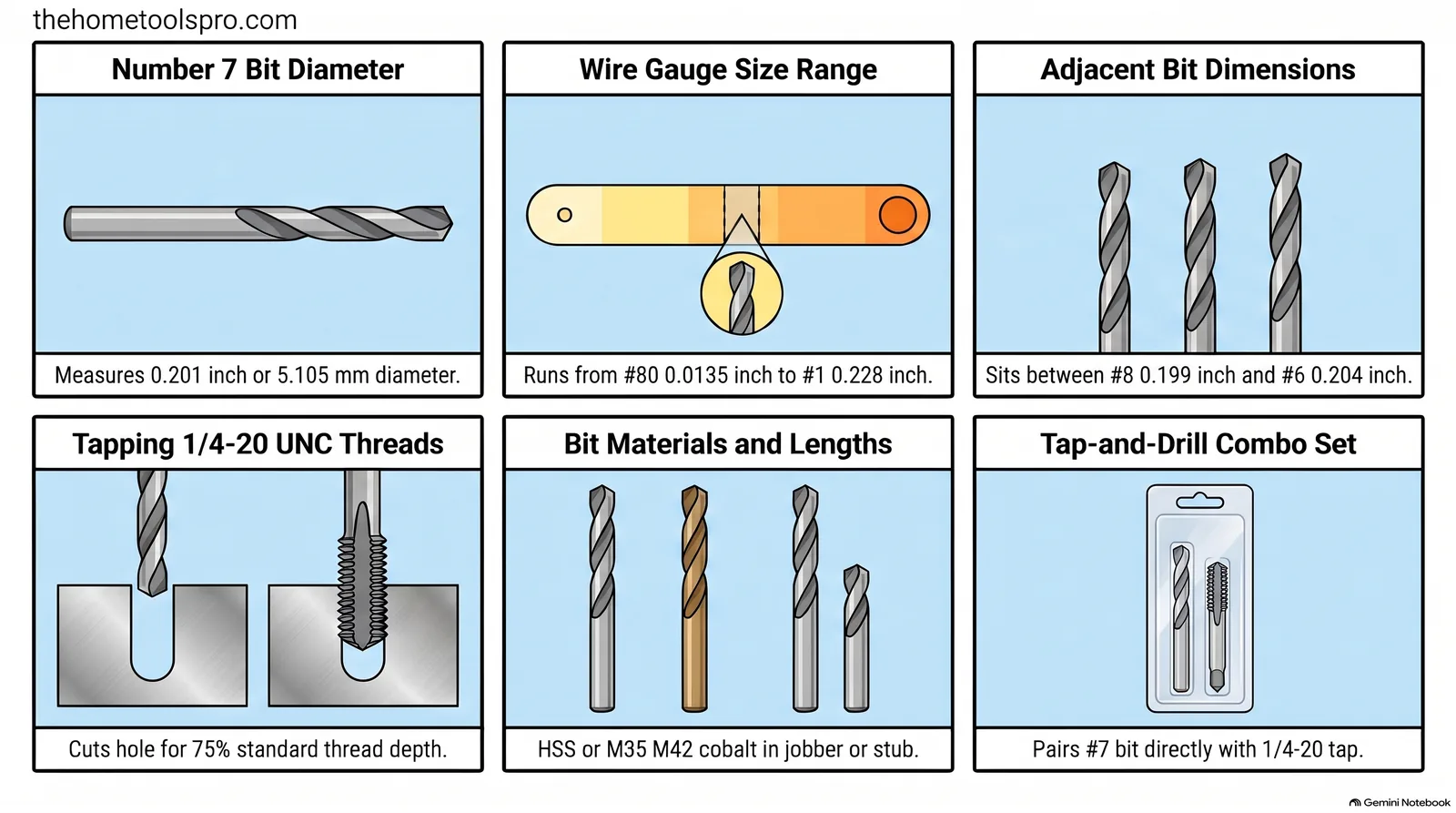
A number 7 drill bit is 0.201 inch in diameter, which is 5.105 mm. It sits between a #8 (0.199 in) and a #6 (0.204 in), and it’s a hair smaller than a 13/64-inch bit (0.203 in). The closest metric bit is 5.1 mm. Most people look it up because it’s the tap drill for a 1/4-20 thread.
The #7 and the sizes around it
| Bit | Inches | Millimeters |
|---|---|---|
| #8 | 0.199 | 5.055 |
| 5.1 mm | 0.2008 | 5.100 |
| #7 | 0.201 | 5.105 |
| 13/64 in | 0.2031 | 5.159 |
| #6 | 0.204 | 5.182 |
| #5 | 0.2055 | 5.220 |
The differences are a few thousandths of an inch, so in wood or plastic any of these makes nearly the same hole. They matter for tapping and for close-fit holes in metal.
How number drill sizes work
Number (or wire gauge) sizes run from #80, the smallest at 0.0135 inch, up to #1, the largest at 0.228 inch. The number goes down as the bit gets bigger. Above #1, letter sizes take over, from A (0.234 in) to Z (0.413 in).
Number and letter sizes fill the gaps between fractional bits, which go up in 1/64-inch steps. That’s why machinists and tap charts use them: a tap drill often needs a size that no fractional bit hits exactly. The full list of number, letter, fractional and metric bits is in the drill bit size chart.
What a #7 drill bit is used for
The #7 is the tap drill for a 1/4-20 UNC thread. Drill a #7 hole, then a 1/4-20 tap cuts a thread with about 75% depth, the standard for tapped holes. The 1/4-20 tap drill bit size guide covers the clearance holes for the same bolt and how to tap the hole.
Other uses are simply holes of about 0.2 inch where a drawing or a part’s instructions call for a #7.
Buying a #7 bit
A #7 is sold on its own or in a number drill set (most cover #1 to #60). Common materials:
- High-speed steel (HSS): fine for wood, plastic, aluminum and mild steel.
- Cobalt (M35 or M42): for stainless and harder steels, where HSS dulls quickly.
Jobber-length bits are the standard length; screw-machine (stub) length bits are shorter and stiffer, which helps them start accurately in metal. If you’re tapping 1/4-20 holes, a tap-and-drill set that pairs the #7 with the tap saves hunting for the right bit.
Related guides
Frequently asked questions
Is a #7 drill bit the same as 13/64?
Almost. A #7 is 0.201 inch and 13/64 is 0.203 inch, a difference of 0.002 inch. For most jobs they're interchangeable; for tapping, the #7 is the size the charts list.
Is a #7 bit bigger than a #8?
Yes. In the number system, a lower number is a bigger bit. A #8 is 0.199 inch and a #6 is 0.204 inch.
What is a #7 drill bit used for?
Mostly for the tap drill hole of a 1/4-20 UNC thread. It's also used wherever a hole just over 0.2 inch is needed, for example on drawings that specify number sizes.
Related guides
- Guide
Hole Saw Sizes: Chart From 3/4 in to 6 in and Uses
Standard hole saw sizes in inches and mm, what each size cuts, which hole saw type suits wood, metal, tile and masonry, and how to cut a clean hole.
- Best picks
6 Best Brad Point Drill Bit Sets for Woodworking
Brad point drill bit sets for clean, accurate holes in wood: what the center spur does, sizes and shank types, plus six sets compared.
- Guide
Can You Drill Through Cast Iron? Bits, Speed and Steps
Yes, cast iron can be drilled with cobalt or TiN-coated HSS bits. Which bit, what speed, why gray iron is drilled dry, and the step-by-step method.