Ryobi vs Milwaukee vs DeWalt: Which Battery Platform?
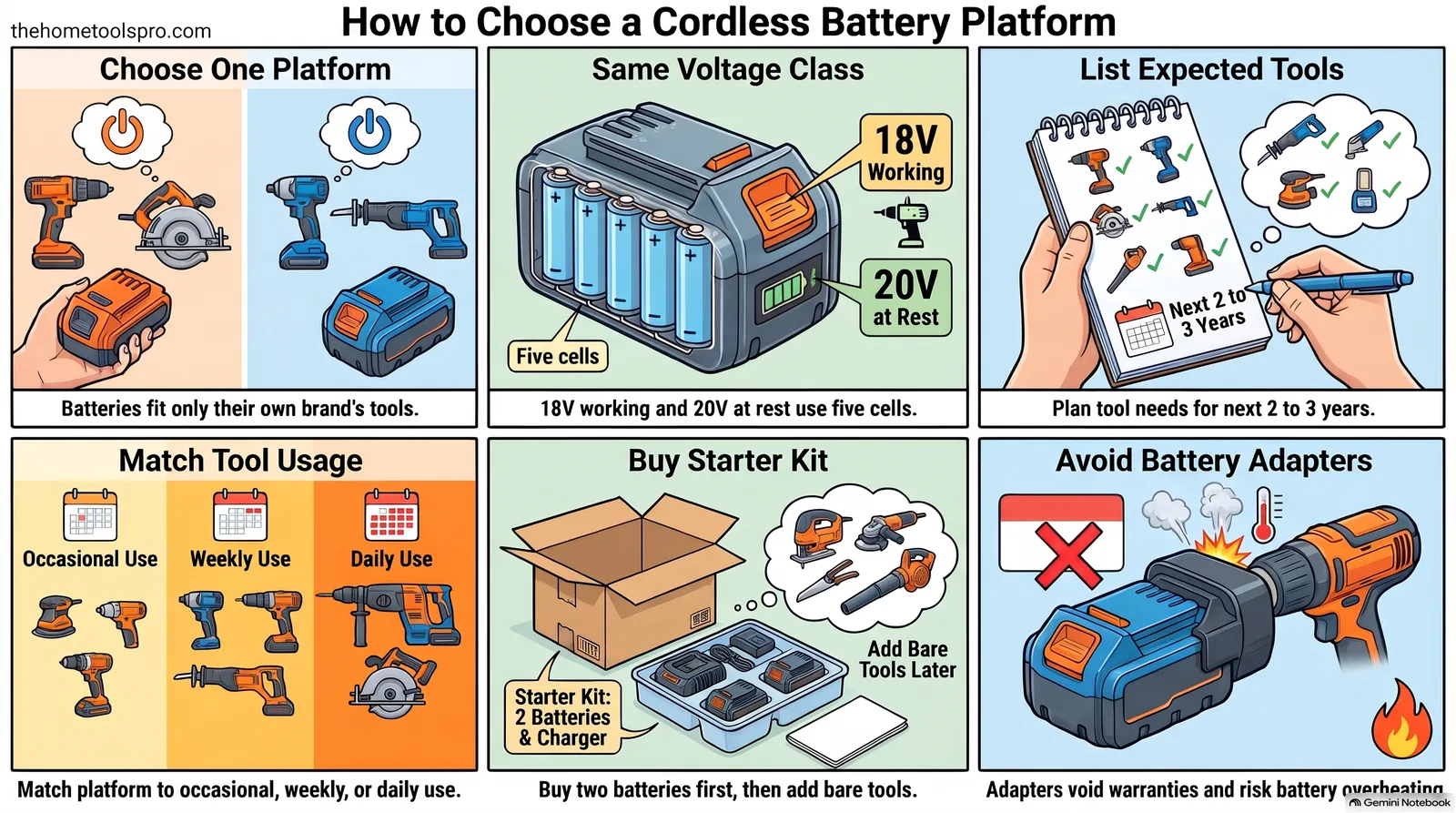
Choose one battery platform and stay with it: batteries and chargers fit only their own brand’s tools, so the platform you pick decides every cordless tool you buy afterwards. For homeowners on a budget, Ryobi 18V ONE+ has a very wide range of home and garden tools at low prices. For heavier and daily use, the main systems are Milwaukee M18, DeWalt 20V Max and Makita 18V LXT. Pick the platform by the tools you expect to need over the next few years, not by the drill that happens to be on sale.
The main platforms compared
| Platform | Voltage class | Best suited to | Known for |
|---|---|---|---|
| Ryobi 18V ONE+ | 18V | Homeowners, DIY, garden | Very wide, low-cost range; long-running battery compatibility within ONE+ |
| Milwaukee M18 | 18V | Trades, heavy use | Large pro range, strong high-demand tools |
| Milwaukee M12 | 12V | Compact tools, second platform | Small drivers, ratchets, inspection tools |
| DeWalt 20V Max | 18V class (20V Max) | Trades and serious DIY | Wide pro range; FlexVolt packs also run 20V tools |
| Makita 18V LXT | 18V | Trades and DIY, including outdoor tools | Large range with many outdoor tools on the same battery |
| Bosch 18V | 18V | DIY and pro | Well-made drills and drivers; smaller US range |
| Ridgid 18V | 18V | DIY and pro | Sold mainly through Home Depot in the US |
| Craftsman V20, Hart, Kobalt 24V | 20V / 24V | Budget DIY | Lower prices; ranges vary by shop and country |
“20V Max” and “18V” describe the same battery class: five lithium-ion cells, about 18V working and 20V at rest. Cordless drill voltage explains the numbers.
How to choose
- List the tools you’ll want in the next 2 to 3 years: drill and impact driver for most people, then perhaps a circular saw, oscillating tool, sander, lights, a leaf blower or string trimmer.
- Check that the platform has them, at a price you’ll pay.
- Match the platform to how hard you’ll use the tools:
- occasional home use: a budget platform does the job and saves money;
- weekly projects or a side business: a mid- or pro-grade platform lasts longer under load;
- daily trade use: the pro platforms, with their larger batteries and heavy tools.
- Buy a kit with two batteries and a charger first, then add bare tools (no battery) later; that’s where a platform saves money.
- Check local availability and warranty: some brands sell only through one shop chain.
Mixing brands
Batteries don’t fit across brands. Third-party adapters can make one brand’s battery fit another’s tool, but they usually void warranties and can skip the protection circuits that stop a battery overheating or over-discharging. Are cordless drill batteries and chargers interchangeable covers which batteries mix and which don’t.
A second, compact platform
Many people add a 12V system for small tools: compact drivers, ratchets and inspection cameras. That’s fine as long as the main 18V/20V platform covers the heavy tools.
Related guides
Frequently asked questions
Can I use DeWalt batteries on Milwaukee tools?
Not directly. Each brand's battery has its own shape and connection. Third-party adapters exist, but they usually void the warranty and can bypass the tool's protection circuits.
Is Ryobi good enough for home use?
For most homeowners, yes. Ryobi ONE+ tools are priced for occasional use, and the range covers drills, saws, sanders, lights and garden tools on one battery.
Should I buy into a 12V or 18V platform?
18V/20V covers more tools and heavier work. A 12V system such as Milwaukee M12 or Bosch 12V is a good second platform for compact tools, but rarely the only one.
Related guides
- Guide
Power Tool Combo Kits: What to Look For Before Buying
How to choose a cordless power tool combo kit: battery platform, which tools you'll use, battery size, brushless motors, charger and what's left out.
- Guide
Can I Use an 18V Battery in a 14.4V Drill? Risks Involved
Why an 18V battery shouldn't go in a 14.4V drill: cell counts, what the extra voltage does to the motor, and the same answer for 12V and 24V tools.
- Guide
How to Charge a Drill Battery Without a Charger (Safely)
Why a lithium drill battery needs a charger made for it, the safe ways to charge it when yours is missing or far from an outlet, and the methods to avoid.