Can I Use an 18V Battery in a 14.4V Drill? Risks Involved
No, you shouldn’t use an 18V battery in a 14.4V drill. A lithium-ion 14.4V battery has four cells and an 18V battery has five, so the 18V pack delivers about 25% more voltage than the drill was designed for. The motor spins faster and draws more current, and the trigger switch, electronics and motor windings run hotter than their rating. That can burn out the drill quickly, and the maker’s warranty won’t cover it.
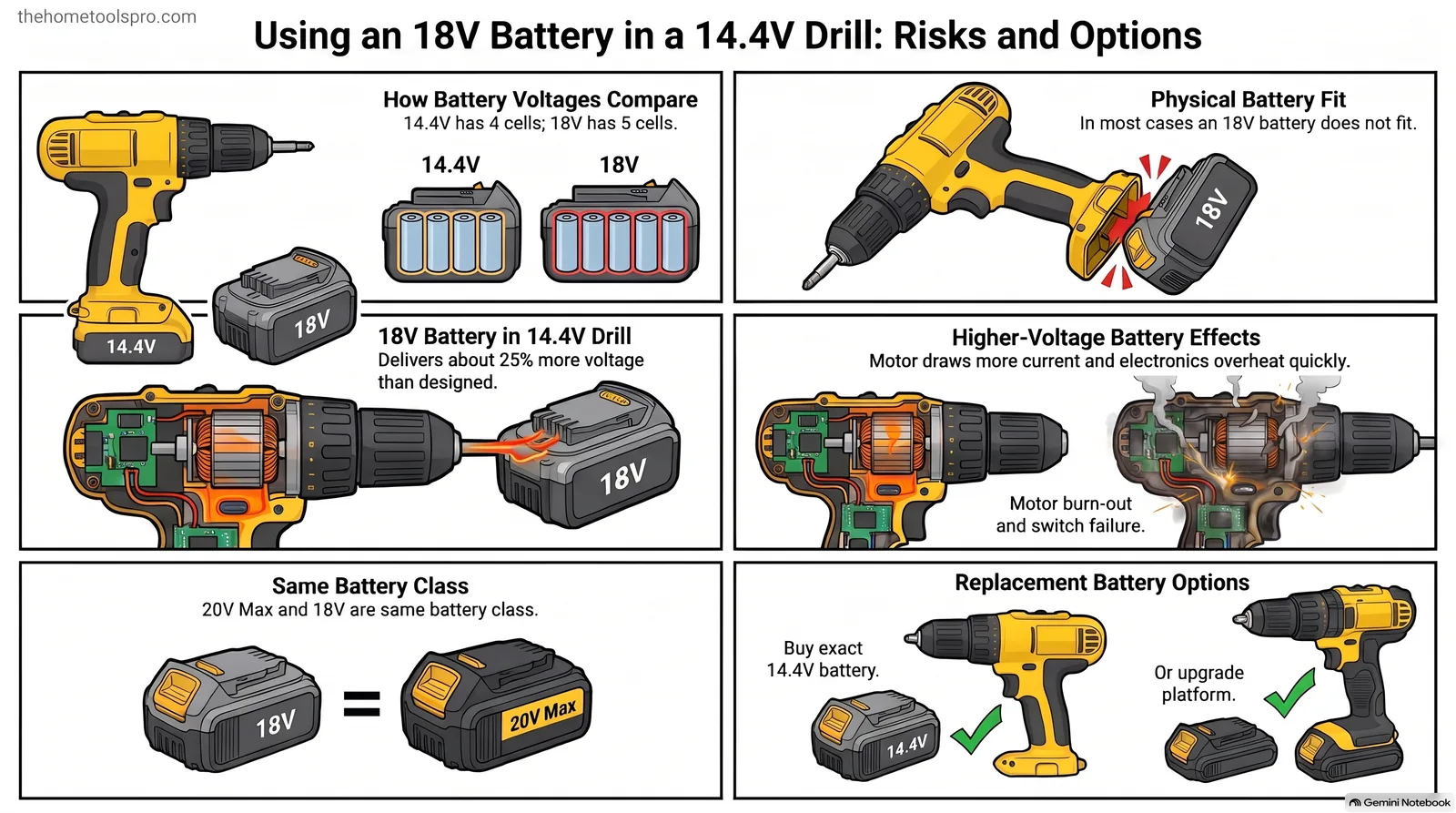
In most cases the question doesn’t come up, because an 18V battery doesn’t fit a 14.4V drill. A few brands used the same slide style for their 14.4V and 18V lithium packs, so the pack will slide in; their manuals still say to use only the rated voltage.
How drill battery voltages compare
| Battery | Lithium-ion cells | Nominal voltage |
|---|---|---|
| 12V Max | 3 | 10.8V |
| 14.4V | 4 | 14.4V |
| 18V / 20V Max | 5 | 18V |
| 36V / 40V Max | 10 | 36V |
Each lithium-ion cell is 3.6V nominal and about 4V when fully charged, which is where the “Max” names come from: a five-cell pack is 18V working and 20V Max at rest. 18V and 20V Max are the same class of battery, but they still fit only their own brand’s tools. Are cordless drill batteries and chargers interchangeable explains which batteries swap.
Older nickel-cadmium (NiCd) packs reach the same voltages with more, smaller cells (12 cells for 14.4V, 15 for 18V), but the rule is the same.
What happens with a higher-voltage battery
A drill’s motor, switch and control electronics are sized for one voltage. With a higher-voltage battery:
- the motor turns faster and pulls more current under load, so it heats up much sooner;
- the trigger switch and speed control carry more current than they’re rated for and can fail, sometimes stuck on;
- brushes and the gearbox wear faster from the extra speed;
- on brushless tools the electronics may shut down, or be damaged.
A stalled bit or a heavy cut makes all of this worse, because current peaks when the motor is loaded.
Other voltage combinations
| Battery | Tool | Fits? | Safe? |
|---|---|---|---|
| 18V | 14.4V | Usually not | No: about 25% over the rated voltage |
| 14.4V | 18V | Usually not | Not recommended: low power, may not run |
| 18V | 12V Max | No | No: five cells in a three-cell tool |
| 24V | 18V | No | No: a different platform |
| 20V Max | 18V, same brand and platform | Yes | Yes: the same battery class |
If you need a battery for a 14.4V drill
Buy a 14.4V battery made for that drill, either from the maker or a third-party pack sold for that exact model. If 14.4V packs are no longer made for your platform, moving to a current 18V or 20V Max drill is usually cheaper over time than tracking down old batteries. Either way, charge the battery only on a charger that lists it; how to charge a drill battery without a charger covers the safe options when yours is missing.
Related guides
Frequently asked questions
Can I use a 14.4V battery in an 18V drill?
It's not recommended. Where it fits at all, the drill runs with less power and speed, and many 18V tools won't run on a 14.4V pack. Use the 18V battery the tool was made for.
Can I use an 18V battery in a 12V drill?
No. A 12V Max tool is built for a three-cell battery, and an 18V battery has five cells. It won't fit, and the voltage would overload the tool.
Is a 20V battery safe in an 18V drill?
Within the same brand and platform, 18V and 20V Max are the same five-cell battery under two names, so it's safe. Across brands the batteries don't fit.
Related guides
- Guide
Power Tool Combo Kits: What to Look For Before Buying
How to choose a cordless power tool combo kit: battery platform, which tools you'll use, battery size, brushless motors, charger and what's left out.
- Guide
How to Charge a Drill Battery Without a Charger (Safely)
Why a lithium drill battery needs a charger made for it, the safe ways to charge it when yours is missing or far from an outlet, and the methods to avoid.
- Guide
Are Cordless Drill Batteries and Chargers Interchangeable?
Which cordless drill batteries and chargers swap between tools: across brands, within one brand, between 18V and 20V, and what adapters really do.