How to Charge a Drill Battery Without a Charger (Safely)
You can’t safely charge a lithium-ion drill battery without a charger made for it. The charger controls how much voltage and current go into the cells, stops at the right point and, on most modern tools, checks the battery’s temperature and condition first. When your charger is missing or far from a power outlet, the safe options are another charger from the same brand and battery platform, a replacement charger, or your normal charger running from a car inverter, a portable power station or a generator.
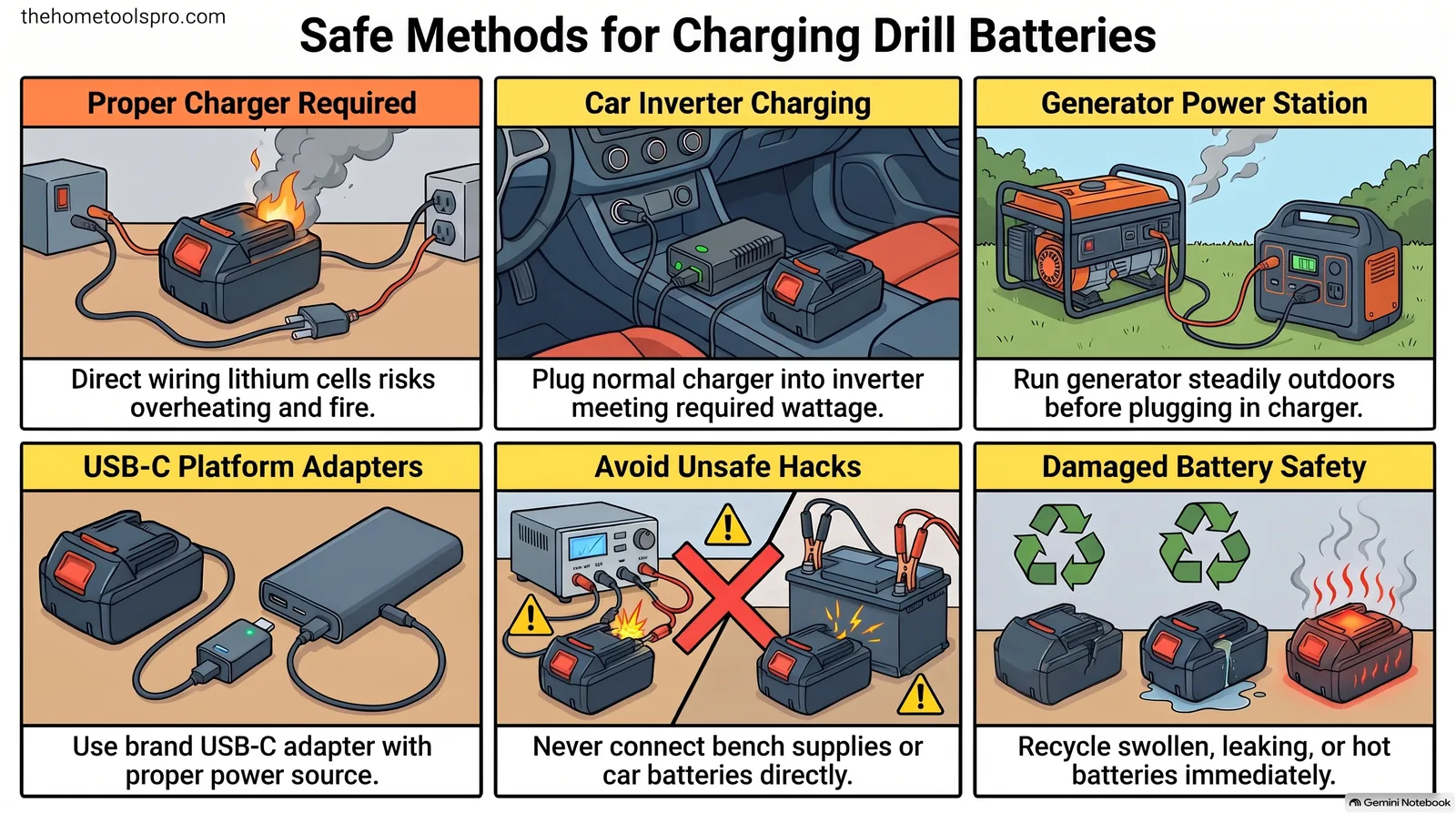
Methods that wire a power supply, a car battery, another battery or a cut-off laptop charger straight to the battery terminals bypass all of that, and lithium cells charged that way can overheat, swell or catch fire.
Why a drill battery needs its own charger
A lithium-ion tool battery is a pack of cells, usually five in series for an 18V or 20V Max battery. Its charger:
- charges with a controlled current, then holds a set voltage and tapers off as the cells fill (lithium-ion cells stop at about 4.2V each);
- won’t start charging if the pack is too hot, too cold or damaged;
- on many platforms, reads data from the battery before and during charging;
- shuts off when the pack is full.
A bench power supply or another battery does none of these, so a pack can be overcharged, charged when it’s too hot, or pushed with too much current.
Safe ways to charge without your own charger
| Situation | Safe option |
|---|---|
| Charger lost or broken | Another charger from the same brand and battery platform, borrowed or bought; or a replacement charger, either official or a third-party one made for that platform |
| No power outlet, near a car | Your normal charger plugged into a power inverter on the car |
| On a job site or off-grid | Your charger running from a portable power station or generator |
| Solar power | A solar generator (panel plus power station) running your normal charger |
| Your brand sells USB-C charging | A USB-C battery, or the brand’s USB charging adapter, with a suitable USB-C power source |
Chargers are platform-specific even within one brand: for example, a 12V charger won’t charge that brand’s 18V packs. Are cordless drill batteries and chargers interchangeable explains which chargers and batteries mix.
Charging from a car
- Use a power inverter that delivers more watts than your charger needs (the wattage is on the charger’s label). A pure sine wave inverter is the safest choice for chargers with electronics.
- Plug the charger into the inverter and the battery into the charger, exactly as at home.
- Run the engine during long charges, so the car battery doesn’t go flat.
Charging from a power station or generator
A portable power station works like a large battery with normal outlets; plug the charger in as usual. With a generator, let it run steadily before plugging in the charger, and keep the generator outdoors, away from windows, because of carbon monoxide.
Methods to avoid
| Method | Why it’s unsafe |
|---|---|
| Bench power supply wired to the terminals | No cut-off and no temperature check; easy to overcharge or overheat the pack |
| Car battery connected straight to the pack | Wrong voltage and no current control; can damage both batteries |
| Another drill battery with alligator clips | Uncontrolled current between two packs; sparks and overheating |
| Laptop charger with the plug cut off | Wrong voltage and current; exposed wires; no protection |
| Solar panel or solar charge controller wired straight to the pack | Controllers for car and lead-acid batteries use different charging voltages from tool packs |
If a battery is swollen, smells, leaks or gets hot without being used, stop using it and take it to a battery recycling point; don’t try to charge it.
When the battery won’t charge on its charger
- Check the charger’s indicator light; most brands list the blink codes in the manual (for example, battery too hot, too cold or faulty).
- Let a hot battery cool, or bring a cold one to room temperature, then try again.
- A battery left flat for months may be too deeply discharged for the charger to accept. Contact the maker or a battery service; “jump-starting” lithium packs with other batteries isn’t safe.
For running a higher-voltage battery in a lower-voltage tool, see can I use an 18V battery in a 14.4V drill.
Frequently asked questions
Can I charge a drill battery with a power bank?
Only if your brand makes a battery or adapter that charges over USB-C. Ordinary power banks can't charge an 18V or 20V tool pack directly, but a large power station can run the normal charger.
Can I charge a drill battery in the car?
Yes, with your normal charger plugged into a power inverter on the car's 12V socket or battery. A pure sine wave inverter with more wattage than the charger draws is the safest choice; run the engine for long charges so the car battery doesn't go flat.
Will a charger from another brand work?
Usually not. Batteries from different brands have different shapes and connections, and many communicate with their own charger. Use a charger from the same brand and battery platform, or a third-party charger made specifically for that platform.
Related guides
- Guide
Power Tool Combo Kits: What to Look For Before Buying
How to choose a cordless power tool combo kit: battery platform, which tools you'll use, battery size, brushless motors, charger and what's left out.
- Guide
Can I Use an 18V Battery in a 14.4V Drill? Risks Involved
Why an 18V battery shouldn't go in a 14.4V drill: cell counts, what the extra voltage does to the motor, and the same answer for 12V and 24V tools.
- Guide
Are Cordless Drill Batteries and Chargers Interchangeable?
Which cordless drill batteries and chargers swap between tools: across brands, within one brand, between 18V and 20V, and what adapters really do.