Track Saw vs Circular Saw: Which Cuts Straighter?
A track saw cuts straighter and cleaner than a circular saw because it rides on an aluminum rail (track) with a rubber anti-splinter strip along the edge. It can also plunge into the middle of a panel. A circular saw is cheaper and handier for framing and rough cuts; with a clamped straightedge it can cut straight too, but it takes more setup and leaves more tear-out.
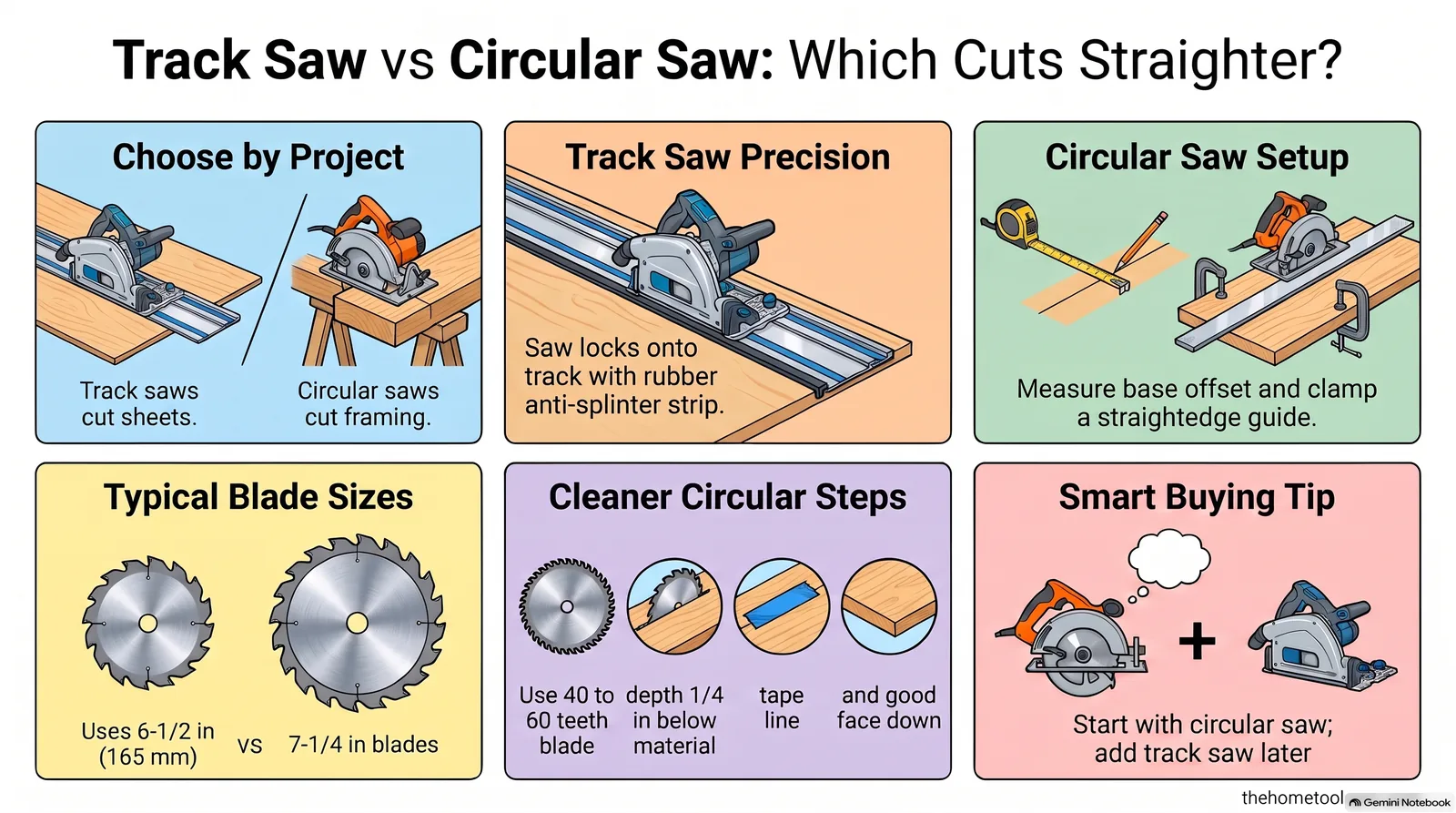
If you mostly cut plywood, MDF, doors and countertops, a track saw is worth it. If you mostly cut 2x4s and framing, a circular saw does the job.
Track saw vs circular saw at a glance
| Track saw | Circular saw | |
|---|---|---|
| Straight cuts | Excellent: the saw locks onto the track | Good only with a straightedge or guide |
| Edge quality | Splinter-free on both sides with the track’s strip | Tear-out on the top face, especially in veneer |
| Plunge cuts | Yes, built for it | Not designed for plunge cuts |
| Setup | Lay the track on the line and cut, no offset to measure | Measure the base offset and clamp a guide |
| Dust collection | Usually good, enclosed blade | Usually poor |
| Framing lumber | Works, but slow to set up | Fast and handy |
| Typical blade | 6-1/2 in (165 mm) | 7-1/4 in |
| Cost | Higher; tracks extra | Lower |
Why a track saw cuts straighter
The track’s splinter strip is trimmed by the saw on its first cut, so the strip’s edge is the cut line. You lay the edge on your pencil marks and cut: no offset to calculate. The rubber underside grips the work, so many cuts need no clamps. The saw’s base runs in a profile on the track, so it can’t wander.
A circular saw has a flat base and a blade offset from the base edge, so you measure that offset and clamp a straightedge. Any flex in the guide or drift in your push shows in the cut.
When a circular saw is the better buy
- Framing, decking and fencing: speed matters more than a perfect edge.
- Rough cuts and demolition.
- Cutting tile, stone or metal with the right blade (a dedicated blade for each material). For tile, see can you cut tile with a circular saw.
- Tight budgets: a good circular saw plus a homemade straightedge jig gets close to track-saw results on plywood.
Circular saw blades are tougher than many people think; are circular saw blades hardened explains what the blade and its teeth are made of.
Getting cleaner cuts from a circular saw
- Use a fine-tooth blade (40 to 60 teeth) for plywood and veneers.
- Cut with the good face down, because a circular saw blade tears the top face.
- Score or tape the cut line with masking tape to reduce splintering.
- Clamp a straightedge, and support both sides of the cut so the piece doesn’t drop and pinch the blade.
- Set the blade depth about 1/4 in below the material.
Which should you choose?
- Mostly sheet goods and finish work: track saw.
- Mostly framing and outdoor projects: circular saw.
- Both, on a budget: circular saw now, plus a straightedge guide, and a track saw later if you cut a lot of plywood.
Frequently asked questions
Can a circular saw replace a track saw?
For framing and rough cuts, yes. For finished edges on plywood, melamine and doors, a circular saw needs a straightedge guide and tape or a zero-clearance base to come close, and it still can't plunge cleanly.
Can a track saw replace a table saw?
For breaking down sheet goods, often yes, and it's safer. For narrow rips, repeated identical strips and dadoes, a table saw is still faster.
Do track saws work with any track?
Tracks are made for their own saw base. Some brands share a common track profile; others need an adapter. Check compatibility before mixing brands.
Related guides
- Guide
Can I Cut Aluminum With a Chop Saw?
Yes, a chop saw cuts aluminum with a carbide blade made for non-ferrous metal. Which blade, how to set up the cut, and the safety steps.
- Guide
Can a Wood Bandsaw Cut Metal? Speed and Blades
A wood bandsaw runs too fast for most metal. Blade speeds compared, what a wood bandsaw can cut (aluminum, brass), and how to slow one down.
- Guide
Can You Cut Plexiglass With a Bandsaw?
Yes, a bandsaw cuts plexiglass with a fine-tooth blade and steady feed. Blade TPI, speed, how to stop melting and chipping, and safety tips.