7018 Welding Rod: Uses, Amperage and Storage
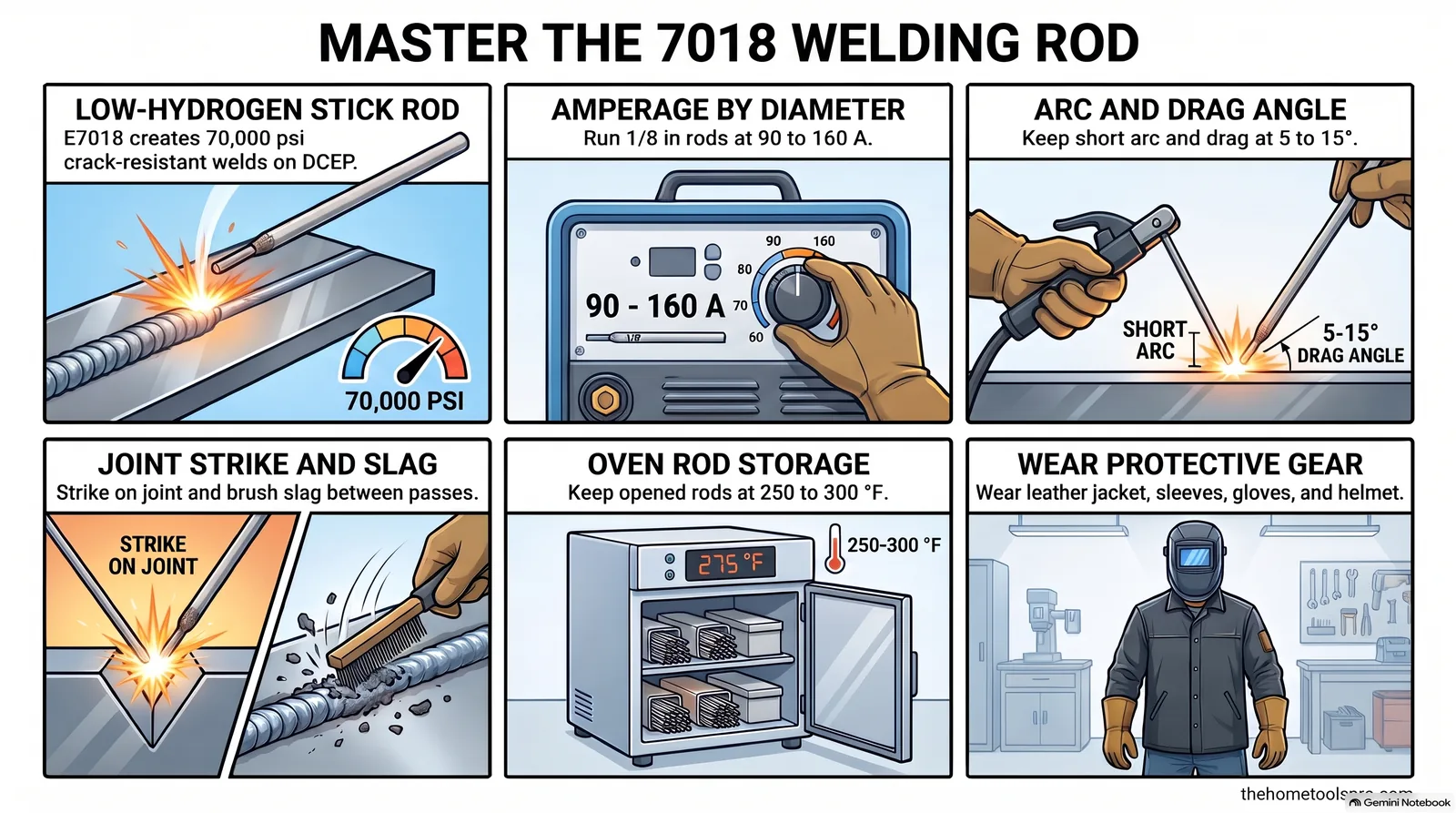
E7018 is a low-hydrogen stick (SMAW) welding rod that makes strong, crack-resistant welds in carbon steel, in all positions. It’s run on DC electrode positive (DCEP) at roughly 70 to 110 A for 3/32 in, 90 to 160 A for 1/8 in and 130 to 220 A for 5/32 in rods. Its one weakness is moisture, so keep it dry: once the sealed can is opened, store the rods in a rod oven.
What the numbers mean
| Part | Meaning |
|---|---|
| E | Electrode |
| 70 | 70,000 psi minimum tensile strength of the weld metal |
| 1 | Usable in all positions (flat, horizontal, vertical, overhead) |
| 8 | Low-hydrogen potassium flux with iron powder; DCEP (or AC for the AC versions) |
These follow the AWS A5.1 classification for carbon steel electrodes.
What 7018 is used for
- Structural steel: beams, columns, brackets, building frames.
- Heavy equipment and trailers, where welds must resist cracking under load.
- Thick and high-strength carbon steel that cracks easily with other rods.
- Welding certification tests: many structural tests use 7018, often in the 3G and 4G positions.
It gives a smooth bead with an easy-to-remove slag, which is why many welders learn it early. Compared with 6010 and 6011 rods, 7018 penetrates less deeply but gives a stronger, cleaner and more crack-resistant weld. For how stick welding compares with MIG and TIG, see types of welding.
Amperage by rod size
| Rod diameter | Typical amperage | Typical metal thickness |
|---|---|---|
| 3/32 in (2.4 mm) | About 70 to 110 A | Thin to medium plate |
| 1/8 in (3.2 mm) | About 90 to 160 A (often 110 to 150 A) | The most common general size |
| 5/32 in (4.0 mm) | About 130 to 220 A | Thicker plate, flat and horizontal |
The rod maker’s box gives the exact range. Use the higher end flat and horizontal, the lower end vertical and overhead.
Tips for running 7018
- Keep a short arc: about the diameter of the rod. A long arc lets air in and causes porosity.
- Drag the rod at a slight angle (about 5 to 15°) in flat and horizontal positions.
- Weave or step slightly on vertical-up welds, pausing at the edges to fill.
- Strike on the joint, not beside it: arc strikes outside the weld can crack.
- Chip and brush the slag off between passes.
Storing and re-drying 7018 rods
Low-hydrogen rods absorb moisture from the air, which puts hydrogen in the weld and can cause cracking.
| Situation | What to do |
|---|---|
| Sealed can | Store dry; it stays fresh until opened |
| Opened | Keep in a rod oven at about 250 to 300 °F (120 to 150 °C) |
| Out of the oven | Codes such as AWS D1.1 limit exposure, commonly to about 4 hours for E7018 |
| Damp or over-exposed | Re-dry (re-bake) in an oven at the higher temperature the maker lists, typically about 650 to 750 °F (345 to 400 °C) for an hour or so |
Never use rods with cracked, chipped or crumbling flux. For home use, a sealed plastic container with desiccant helps between jobs, but for code or structural work a rod oven is the standard.
7018 and welding safety
Stick welding throws more spatter and slag than MIG or TIG: wear a leather jacket or sleeves, gloves and a helmet with the right shade. See welding safety tips, and what is welding for how stick welding fits among the other processes.
Related guides
Frequently asked questions
What does 7018 stand for?
E = electrode; 70 = 70,000 psi minimum tensile strength; 1 = all welding positions; 8 = low-hydrogen iron-powder flux, usable on AC or DCEP depending on the rod (DCEP is standard).
Can I weld 7018 with an AC welder?
Standard 7018 runs best on DC. Rods labelled 7018AC are made to run on AC-only welders.
What happens if 7018 rods get damp?
The flux absorbs moisture, which adds hydrogen to the weld. That causes porosity and can lead to cracking, especially in thick or high-strength steel. Damp rods must be re-dried in a rod oven.
Related guides
- Guide
Stick Welder: Amps, Rods and What to Look For
How a stick welder works, how much amperage and duty cycle you need, which rods (6011, 6013, 7018) go with which jobs, and AC vs DC machines.
- Guide
5G Welding Position: Technique, Equipment and Safety
The 5G welding position: a fixed horizontal pipe welded all the way round. Setup, uphill and downhill technique, equipment, and why it's tested.
- Guide
Welding Jackets: Leather vs FR Cotton vs Hybrid
How to choose a welding jacket: leather, flame-resistant cotton or hybrid, which suits MIG, TIG and stick welding, fit, length and what never to wear.